


From a LinkedIn Comment to a Civilizational Signal: What the Art at Plan ₿ Forum Revealed About the Future of Money, Coordination, and Sovereignty

It all started with a thoughtful comment on LinkedIn. Mukoot Ali, Co-Founder of Werex.com, Chief Executive Officer of Upstake Technologies Private Limited, Vice President of the Kolkata International Blockchain Association, and a recognized champion of innovation and strategic growth, left a dense but precise observation about blockchain’s original logic. Built for trustless transactions and fast speculation, yet holding far greater potential for real coordination. “What happens when you try to slow down something that was designed to move very fast?” he asked. That friction, he said, is where the real work lives.

His comment struck me deeply. Not only because it came from someone with significant hands-on experience building blockchain projects and advancing the ecosystem in India and internationally, but also while attending Plan ₿ Forum in El Salvador, I experienced something that seemed to answer him directly. That combination of insight and timing gave me the sync I needed to finally organize the notes I had been gathering and connect them to this exact conversation.
Among the immersive installations, one work by artist Antonio Batzu stood out powerfully. He presented Bitcoin explicitly as “The Digital Ark”, a vessel of salvation floating above a sea of fiat. Some figures were drowning, others climbing aboard. His accompanying texts connected the Greek concept of Logos (the divine reason that orders the cosmos) directly to Bitcoin as its embodiment in silicon, alongside references to the Paracletus guiding humanity into all truth.


The immersive video tunnel was equally profound. Walking inside an infinite corridor of glowing Bitcoin symbols with reflections and transforming geometric patterns that evoked quantum fields and fluid dynamics, it became clear these were not decorative elements. They were encrypted messages signaling a profound civilizational transition in how value, coordination, and truth are mediated.
Throughout history, art and visual propaganda have consistently served to announce and normalize major paradigm shifts, from the Renaissance and the Reformation to the Enlightenment and the Industrial Revolution. What we are witnessing now follows the same pattern. Visual and symbolic language is preparing the collective imagination for a new monetary and coordination architecture.
This connects directly with Mukoot’s question. Blockchain was born for trustless transactions. But its deeper potential lies in coordination at scale without requiring trust in centralized intermediaries. The friction appears precisely when we try to bend fast, transparent, immutable systems back into the slow, opaque logic of traditional banking.
That old architecture rests on a foundational fallacy. The belief that a central authority can sustainably create money ex nihilo, manage risk through opacity, and maintain coordination through control. The current tensions between the Trump administration and the Federal Reserve, along with figures like Ricardo Salinas Pliego pushing Bitcoin into traditional banking rails (Banco Azteca), reveal the cracks.
What we are seeing, both in the art and in the macro, is the early attempt to build new financial engineering on verifiable truth rather than narrative control. Blockchain provides the rails. Stablecoins are already replacing fiat in the medium to long term by enabling near-instant, low-cost transfers and optimizing remittances, where time literally equals money. Quantum computing, hinted at in the fluid and geometric patterns of the immersive installations, will eventually supercharge the optimization and security layers. Together they allow coordination that is faster, more transparent, and harder to capture than anything the 20th-century banking model was designed to do.
This is not merely technological evolution. It is a philosophical and civilizational one.
Why This Matters for Guatemala and Latin America
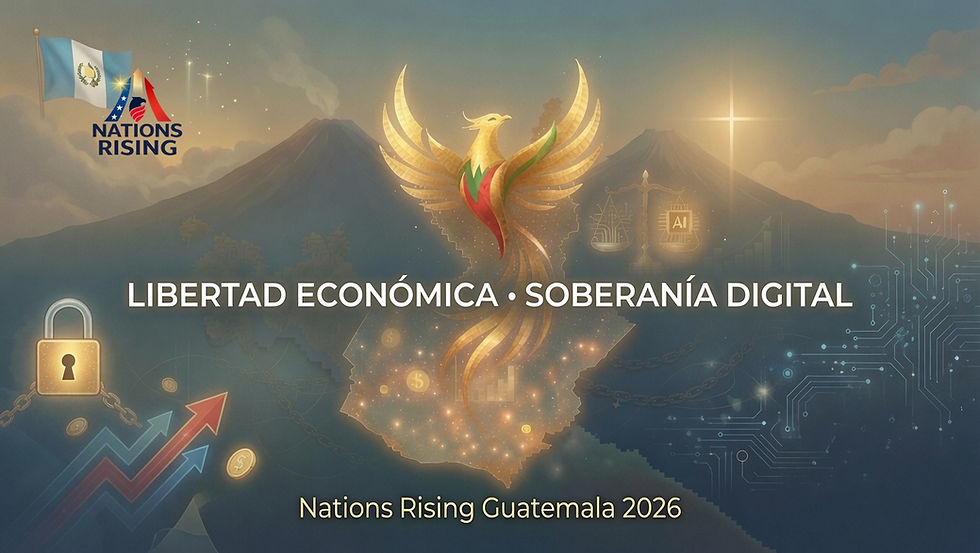
This experience in El Salvador came at the perfect moment, right before participating in Nations Rising Guatemala. In that forum I argued that before speaking of economic freedom or digital sovereignty, Guatemala must first recover the capacity to think without permission and reclaim its financial future from imported regulatory and ideological frameworks.
It was thanks to the invitation and support of Luis Figueroa (Founder & Chairman of the
International Conservative Leadership Council), a key voice in the Guatemalan liberty movement with a strong advocate for economic freedom, rule of law, and limited government, that I was able to attend and later share a note from the event. His work continues to demonstrate how individuals and networks aligned with Austrian School principles are actively building the intellectual and practical foundations for these changes in Central America.

The AML reform Initiative 6593 is necessary, but insufficient if it remains only about more control. The real question is whether it will serve as a platform for genuine financial modernization or simply expand a compliance framework that keeps us dependent on the old coordination layer.
In my earlier piece on Quantum Computing, Flow States, and Professional Consciousness, I explored how the convergence of these technologies with expanded states of awareness will redefine work and governance: “When a critical mass of individuals begins to operate from these levels of consciousness and mental coherence, a collective resonance emerges. That resonance is exactly what can help eliminate corruption, bureaucracy, and obsolete systems.”
And in Freedom, Consciousness, and Value: “Freedom is the fuel of innovation. Consciousness is its direction. Human flow is its silent engine. Conscious observation is the portal into the quantum.”
The art in El Salvador, Mukoot’s question, and these threads converge on one point. We stand at the threshold of a new era where technology, consciousness, and sovereignty must align.
Stablecoins, Local Banking Revolution, and International Integration
Stablecoins are particularly relevant for Guatemala and Latin America. They offer a bridge between local realities and global markets by providing dollar-like stability with blockchain speed and transparency. For a country with high remittance flows, they dramatically reduce costs and settlement times, turning “time is money” into a practical reality for families and businesses.
On the trade front, stablecoins enable more efficient international commerce by minimizing FX volatility and correspondent banking frictions. Local banks that integrate these mechanisms into their cores can interact seamlessly with modern international institutions already adopting similar rails. This is not disruption for its own sake. It is evolution. Banks that embrace programmable money, tokenization, and real-time settlement will move from intermediaries of friction to facilitators of flow.
Digital Sovereignty in LatAm: Who Is Better Positioned?
Digital sovereignty, the ability to control one’s financial rails, data, and monetary architecture, is becoming a defining issue for the region. Countries whose political ideologies align more closely with Austrian School principles (sound money, individual liberty, free markets, and skepticism of central planning) tend to face fewer setbacks in adopting these technologies. Nations governed by right-leaning or libertarian-leaning administrations often show greater openness to innovation-friendly regulation, regulatory sandboxes, and private-sector leadership in fintech.
El Salvador’s bold Bitcoin experiment is the clearest example, but others in the region with similar ideological leanings are watching closely. The contrast is evident when compared to more statist approaches that prioritize control over competitiveness.
Guatemala stands at a crossroads. As I argued in the Nations Rising piece, we must build institutions that guarantee security, justice, and clear rules while unleashing private innovation. Regulation and modernization are not enemies. They can be complementary when guided by wisdom and discernment.
The Digital Ark is not merely a symbol. It is an invitation. The question is whether we board it, or continue drifting in a sea of fiat and centralized control.


Comments