


Mandatory Ethanol in Guatemala:When State Environmentalism Turns the Consumer into a Captive Customer

Updated: Sep 1

Editorial Note
The companies, corporate groups, trade associations, businesspeople, and executives mentioned in this article appear exclusively because of their public, registry-based, historical, or institutional ties to companies that produce, distribute, or could obtain economic benefits from the mandatory implementation of ethanol in Guatemala.
Their inclusion does not constitute an accusation of corruption, influence peddling, unlawful participation in the drafting of regulations, illicit enrichment, or personal intervention in government decisions. Nor does it imply that every shareholder, director, executive, or member of the business families mentioned directly promoted the measure.
This analysis distinguishes between the potential economic benefit arising from demand created by state regulation and the existence of unlawful conduct. The fact that a company is positioned to benefit from a public policy does not, by itself, prove that it acted improperly to obtain that benefit.
References to public officials, legislators, political parties, and business organizations are intended to identify institutional responsibilities, publicly documented relationships, and possible conflicts of interest that deserve transparency and citizen oversight. Any allegation of individual responsibility must be supported by official documents, contracts, corporate records, public statements, competent investigations, or judicial decisions.
The purpose of this article is to promote debate on freedom of choice, competition, regulatory proportionality, consumer protection, and the relationship between political power and economic interests—not to present suspicions or inferences as proven facts.
Utilitarianism, Deontology, and the Morality of Compelling Others
Every public policy should begin with a moral question that precedes the economic calculation: is it legitimate to force a person to use his or her property in a particular way in order to produce a collective benefit that the State has defined on that person’s behalf?
Utilitarianism holds that an action is right when it produces the greatest welfare for the greatest number of people. Under that logic, a government could justify imposing ethanol in gasoline by arguing that it reduces emissions, strengthens domestic production, decreases dependence on petroleum, or produces environmental benefits for the majority.
The problem appears when that supposed general welfare is built by transferring costs, risks, and freedom from millions of citizens to a small group of public and private actors. If the aggregate benefit requires a family to risk its vehicle’s fuel system, a motorcyclist to accept a fuel he did not choose, or a small carrier to absorb a reduction in energy efficiency, the utilitarian calculation begins to look less like altruism and more like the centralized administration of someone else’s sacrifice.
The citizen does not voluntarily participate in that altruism. He is compelled to finance it.
Deontology, especially in its Kantian tradition, sets another limit: human beings must be treated as ends in themselves, not merely as instruments for achieving political, environmental, or business objectives. Helping others may constitute a rational duty, but no authority should reduce the individual to a variable inside a formula in which property, mobility, and economic capacity are sacrificed because a bureaucracy believes the aggregate outcome will be positive.
True altruism requires freedom. A voluntary action can be generous. A transfer imposed by force may be presented as solidarity, sustainability, or climate justice, but it remains coercion.
That is why the debate over ethanol in Guatemala is not merely technical. It is a moral debate about who decides, who pays, who bears the risk, and who receives the benefit.
This tension can also be read through the Christian faith. Micah 6:8 does not reduce morality to producing a convenient outcome; it calls for doing justice, loving mercy, and walking humbly with God. Justice, therefore, does not consist in silently sacrificing the individual to satisfy a collective calculation, but in recognizing human dignity and acting humbly in the face of the limits of human power. Likewise, James 2:1–4 condemns partiality that treats the powerful and the weak differently. A policy that concentrates benefits in actors with economic capacity while distributing risks among dispersed citizens should be examined in light of that principle.
The Problem Is Not Ethanol: It Is the Mandate
Guatemala can produce ethanol. Sugar mills have the right to develop it, export it, compete, and offer it as an energy alternative. Distributors can also import it, blend it, and market it, provided that consumers are properly informed.
What does not belong in a free market is for the State to determine that practically the entire population must buy it.
The implementation rests on Decree-Law 17-85, the Fuel Alcohol Law, approved in 1985. Four decades later, the Executive Branch under President Bernardo Arévalo decided to reactivate and regulate that legislation through Government Agreement 257-2025. The scheme provides for the introduction of E10 gasoline, composed of 90% gasoline and 10% ethanol. After changes to the schedule, the Ministry of Energy and Mines announced that regular E10 gasoline would begin to be marketed on August 22, 2026.
After several calendar adjustments, the Ministry presented the initial rollout—regular gasoline first, while premium gasoline remained subject to technical opinions—as a prudent measure and, in some communications, as an initial stage that would allow consumers to choose.
That distinction deserves careful scrutiny. When a policy is designed from the outset as a generalized blending mandate and is then temporarily fragmented into 'regular first, then we will see,' it does not create a structurally voluntary alternative. It manages the pace of the imposition. The word 'initially' does not contradict the objective; it sequences it. It reduces immediate resistance, dilutes the perception of total coercion, and allows a policy whose horizon remains generalized captive demand to be presented as gradual and consultative.
If the legitimate purpose were simply to offer a competitive energy option, it would be enough to authorize the blend and let the market decide. The fact that the State reserves the power to extend it to premium gasoline when technical opinions allow confirms that the announced voluntariness is provisional and subordinate to the same power that creates demand by decree. Consumers do not recover the freedom to reject the product; they are merely granted more time before that freedom narrows further.

This was not a new law broadly debated and approved by Congress in 2026. The operative decision came from the Executive Branch and was developed through governmental and ministerial regulation.
This distinction matters. When a nationwide transformation of the fuel market is carried out through administrative powers derived from a 1985 law, the government may claim that it is acting lawfully. But legality does not necessarily mean economic legitimacy, proportionality, or respect for consumer freedom.
The Executive is not merely allowing ethanol. Through regulation, it is creating demand that previously had to be earned through price, trust, compatibility, and competition.
That is a captive market.
Scripture clearly distinguishes between the voluntary act and what is obtained through pressure. In Philemon 1:14, Paul explains that he did not want to act without consent, so that the good would not be done under compulsion but voluntarily. Although the passage belongs to another context, the moral principle is relevant: a good act loses part of its legitimacy when imposed by force. Exodus 20:15 also protects property against wrongful appropriation. Compelling citizens to use their property to sustain demand they did not choose deserves, at minimum, a much deeper ethical discussion than a mere invocation of the common good.
From the Free Market to Mercantilist Dirigisme
From the principles disseminated by the Foundation for Economic Education and by the classical liberal tradition, a legitimate exchange must be voluntary. Value is not decreed by a minister, a technical committee, or a business association. It emerges from the subjective valuation of the people who exchange.
Carl Menger explained that the value of a good depends on the importance each person assigns to it in satisfying his or her needs. Government destroys that signal when it does not allow the consumer to reject the product.
Ludwig von Mises warned that central planning cannot replace the knowledge transmitted by freely formed prices. Friedrich Hayek developed this point by explaining that markets coordinate dispersed information that no authority possesses in its entirety.
Guatemala has millions of cars, motorcycles, and engines in different conditions. Every owner knows—or should be able to know—the condition of the vehicle, its repair history, its age, and its fuel tolerance. No ministerial resolution can centralize that information better than owners, manufacturers, mechanics, and insurers acting in an open market.
Thomas Sowell would summarize the problem with an essential question: compared with what?
It is not enough to say that ethanol produces benefits. It must be compared with a voluntary system in which E0 and E10 coexist, producers compete on price and performance, and consumers decide according to the compatibility of their vehicles.
Walter E. Williams likewise emphasized that regulations often protect those who already possess capital, licenses, and political access while raising barriers for citizens and small competitors.

The Guatemalan mandate combines precisely these elements: the State selects the direction of the market, authorized producers receive guaranteed demand, distributors move the product, and consumers bear the cost and the risk.
This is not classical socialism because the means of production remain privately owned. Nor is it genuine capitalism because exchange ceases to be voluntary.
It is state dirigisme in the service of private mercantilism.
Or, more directly: a progressive government uses regulatory coercion to create protected private profitability.
The Bible is also not silent about economic favoritism. Proverbs 22:16 warns against oppressing the poor to increase gain and favoring the rich for advantage. The principle does not automatically accuse every company that benefits, but it does require vigilance over any structure in which public rules elevate those who already possess capital, influence, and compliance capacity while ordinary citizens absorb the cost. James 2 rejects precisely a justice system that bends toward those with greater material power.
The ethanol case does not exist in an institutional vacuum. To understand how a policy presented as environmental can end up concentrating decisions, costs, and privileges, it is useful to examine how libertarian theory interprets another recent conflict among the State, the environment, property, and productive activity in Guatemala.
The State’s Ineffectiveness in Environmental Stewardship
A Reading from Libertarian Political Theory
Introduction
The debate over whether the State can rationally manage the balance between development and nature is not new, but the climate crisis has made it urgent. The sustained increase in CO2 emissions and their documented association with respiratory and cardiovascular disease and certain forms of cancer confirms that the question is no longer rhetorical.
Libertarian political theory offers a reading different from the one that dominates public debate. It does not claim that environmental stewardship is irrelevant; rather, it argues that the State, as designed, lacks the incentives and knowledge required to manage it well.
Two failures coexist in practice: the State intervenes with insufficient information, or it intervenes indefinitely and ends up blocking solutions that well-defined property rights could provide more effectively.
The Knowledge Problem and the Incentive Problem
Friedrich Hayek explained that the knowledge relevant to economic and environmental decisions is dispersed among millions of individual actors, communities, companies, scientists, and farmers and cannot be centralized in a ministerial office without losing information.
When the State grants licenses, sets quotas, or suspends productive activities, it decides with incomplete data and under political, not technical, timelines.
To this is added what the public-choice school, associated with James Buchanan and Gordon Tullock, called the incentive problem: public officials do not necessarily maximize the general welfare; they also respond to incentives related to their own political survival.
The State therefore tends toward two extremes: regulatory paralysis, designed to avoid the political risk of making a decision, or regulatory capture, in which the rule ultimately benefits the actor with the greatest lobbying capacity rather than necessarily benefiting the environment.
Against this background, free-market environmentalism, developed by authors such as Terry Anderson and Donald Leal, holds that environmental degradation occurs especially where property rights are diffuse or nonexistent, as in the tragedy of the commons described by Garrett Hardin.

From this perspective, the solution does not necessarily consist of increasing state regulation, but of establishing clear and transferable property rights capable of internalizing environmental costs in the party that chooses to use the resource. Ronald Coase, in his famous theorem, showed that when property rights are well defined and bargaining costs are low, parties affected by an externality such as pollution may negotiate an efficient solution directly, without the need for direct state intervention.
The Escobal Mine Case
The Escobal case in San Rafael Las Flores, Santa Rosa, illustrates both failures of the Guatemalan State.
The exploitation license was granted in 2013 by the Ministry of Energy and Mines to Minera San Rafael, then a subsidiary of Canada’s Tahoe Resources, without conducting the prior consultation required by ILO Convention 169, because state institutions such as RENAP and INE had incorrectly certified that there was no Indigenous population in the area.
That is, in itself, a failure of state information: the administrative apparatus lacked precisely the data that Hayek identifies as indispensable.
In 2017 and 2018, the Supreme Court of Justice and the Constitutional Court suspended operations and ordered the State, through the Ministry of Energy and Mines, to carry out the consultation process with the Xinka people.
That process took seven years.
In 2019, Pan American Silver acquired Tahoe Resources and with it the Escobal project, which remained in a 'care and maintenance' phase, without production, while the State carried out the court-ordered consultation with major delays.
In May 2025, the Parliament of the Xinka People delivered the results: the community rejected continuation of the project.
A common reading of the case should be corrected. This is not a story in which the State closed a mine because of proven environmental damage and then arbitrarily refused to reopen a project that had already been environmentally restored.
The documented facts show something different and, for libertarian theory, equally revealing: the State took seven years to resolve a consultation obligation that should have been fulfilled before the license was granted.
That delay did not better protect the environment or Indigenous rights; it left both in limbo for seven years. Nor did it provide legal certainty to the company or to the roughly one thousand jobs associated with the project.
In public-choice terms, this is the typical cost of a state apparatus that avoids deciding in order to avoid the political risk of deciding incorrectly.
A Libertarian Reading of the Case
From a libertarian perspective, the fundamental problem is not that a consultation process existed.
Recognizing the decision-making capacity of communities over their territory is, in fact, consistent with the principle of self-ownership and with respect for pre-existing rights over the resource.
The problem is that the central State concentrated the matter into a single administrative procedure without binding deadlines—a decision affecting the environment, the community, and employment simultaneously—without enabling direct negotiation mechanisms between the parties.
A framework closer to the Coase theorem would have allowed the company and Xinka communities to negotiate compensation, verifiable environmental guarantees, and binding operating conditions directly, rather than depend on a seven-year ministerial process with no certain date for resolution.
The lesson is not that industry and nature are incompatible, nor that they should be made incompatible by state decree.
It is that a State that neither protects property rights effectively nor resolves the conflicts it creates with reasonable speed ends up producing the worst possible outcome: prolonged legal uncertainty, loss of formal employment, and no verifiable environmental progress for nearly a decade.
The libertarian alternative is not to eliminate every rule, but to move the center of decision-making toward those who actually bear the costs and benefits: communities with recognized property rights and companies subject to real and enforceable civil liability for the environmental damage they cause.
Conclusion
The climate crisis is not solved simply with more State, but with institutions that align the incentives of those who use natural resources with those who bear the consequences.
The Escobal case shows that state intervention, when it finally arrives, often arrives late, incomplete, and without resolving the underlying conflict.
For libertarian theory, the choice is not between the mine and the environment, but between a State that decides through administrative decree and a structure of property rights and responsibility that allows the directly involved parties—the Xinka community and the company—to negotiate, guarantee, and answer for their own decisions.
Who Is in a Position to Benefit
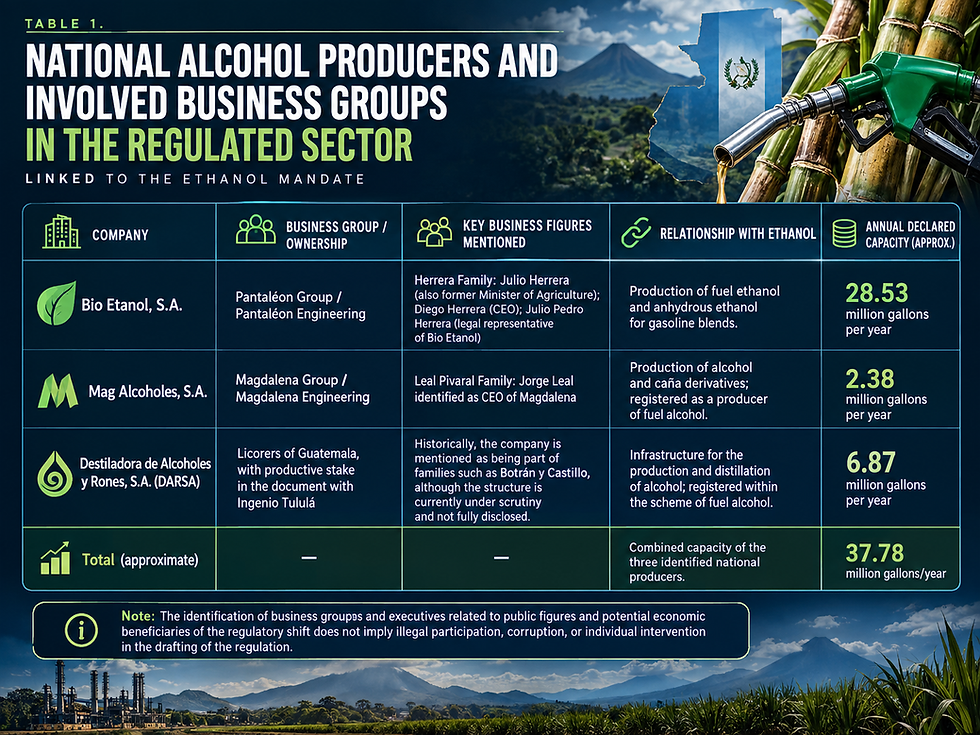
The Ministry of Energy and Mines has registered Bio Etanol, S.A., whose plant is located within the Ingenio Pantaleón complex in Siquinalá, Escuintla; Mag Alcoholes, S.A., publicly linked to the business group of Ingenio Magdalena; and Destiladora de Alcoholes y Rones, S.A. (DARSA), part of the corporate environment of Licores de Guatemala and productively linked to Ingenio Tululá, as domestic producers of fuel alcohol.
These three companies declared a combined annual capacity of approximately 37.78 million gallons. Estimated national demand required to sustain a generalized E10 blend would be considerably higher, which is why the scheme also contemplates imports. Limited domestic capacity does not eliminate the local benefit: registered producers enter a chain whose demand was created through a state mandate.

Grupo Pantaleón and the Herrera Family
Bio Etanol operates within the environment of Grupo Pantaleón, one of the most important agro-industrial organizations in Guatemala and the region. Pantaleón reports operations in Guatemala, Mexico, Nicaragua, Chile, and the United States, more than 17,700 employees, and annual production of approximately 1.1 million tons of sugar and related products.
Pantaleón’s corporate history is directly connected to the Herrera family. Among the business figures identified in the corporate sources reviewed, Julio Herrera appears as chairman emeritus of the group and as a businessman with more than five decades of experience in the sugar industry. Contemporary executive leadership is publicly headed by Diego Herrera, identified as CEO of Grupo Pantaleón.
A business directory also identifies Julio Pedro Herrera Herrick as legal representative of Bio Etanol, S.A. This reference publicly links the company to the Herrera business environment, but it does not prove that every member of the family participated in negotiating the public policy.
Members, shareholders, and executives related to this group may benefit economically from growth in the ethanol market. That is a logical business consequence. The objection is not that they produce and earn profits; it is that demand depends on a general obligation rather than on the free preference of consumers.
Ingenio Magdalena, Mag Alcoholes, and the Leal Pivaral Family
Mag Alcoholes has been publicly identified as a company related to Grupo Magdalena. Historical and business sources link Ingenio Magdalena to the Leal Pivaral family, which acquired the mill during the 1980s and turned it into one of the country’s most important agro-industrial actors.
Recent business information identifies Jorge Leal as CEO of Magdalena since 2017. The company presents itself as a family organization transformed into an agro-industrial, energy, and biotechnology platform, with activities in sugar, electricity generation, alcohol, and other sugarcane derivatives.
There are also journalistic records concerning members of the family and group companies in past political and tax investigations. Those matters must be treated separately and do not prove irregularity in the current implementation of E10. They do, however, show that the discussion concerns one of the sector’s most powerful business groups, not small emerging producers.
DARSA, Licores de Guatemala, and the Liquor Complex
DARSA forms part of the corporate group of Licores de Guatemala, an organization that presents itself as Guatemala’s largest producer and distributor of aged rums and other spirits. The consortium includes production, distillation, bottling, and distribution companies.
Historical ownership of Guatemala’s liquor sector has been publicly associated with business families such as Botrán and Castillo and with other groups linked to the consolidation of the national beverage industry. Contemporary shareholding structures, however, are not fully broken down in the public sources reviewed. Accordingly, it would be irresponsible to state that a specific person individually controls or benefits from DARSA without updated corporate documentation.
What can be established is that DARSA belongs to a large-scale corporation with infrastructure already installed to produce different types of alcohol. Its inclusion in the fuel-alcohol registry places the group in a position to monetize the new demand.
ASAZGUA and the Organized Sugar Sector
The Guatemalan Sugar Association, ASAZGUA, brings together the country’s principal sugar mills. Its members include Pantaleón, Magdalena, Tululá, and other major producers. The organization institutionally represents the interests of the sugarcane agro-industry and promotes alcohol, renewable energy, sugar, and other derivatives as part of its sector strategy.
There is nothing illegitimate about a trade association defending the interests of its members. The conflict arises when the objectives of a private association coincide with a state mandate that eliminates the consumer’s ability to say no. The question Guatemala should ask is not whether ASAZGUA or the sugar mills support ethanol—they naturally have economic reasons to do so—but why the State should guarantee them consumers through a nationwide obligation instead of allowing them to compete to persuade those consumers.
Government, Ministers, and Responsible Officials
Primary political responsibility lies with President Bernardo Arévalo because his administration approved and implemented the regulation that activates the mandatory blend.
The regulation was initially promoted during the tenure of Víctor Hugo Ventura Ruiz, who became Minister of Energy and Mines in January 2024 and remained in office while the new regulatory framework was prepared and approved. Ventura had extensive experience at the Economic Commission for Latin America and the Caribbean (ECLAC/CEPAL), an institution associated with regional development, planning, and energy-transition policies.
On July 2, 2026, Erwin Rolando Barrios Torres became the new Minister of Energy and Mines. He had previously held responsibilities in the ministry’s energy area and participated in the outreach and technical development of the regulation. His administration is responsible for leading the decisive implementation phase.
The ministry’s technical and administrative departments related to energy, hydrocarbons, registration of producers and distributors, storage, imports, and quality control must also be considered.
Not every official involved technically is an ideological author of the policy. Nevertheless, a mandatory transformation of this magnitude requires institutional accountability and traceability. The country should know who recommended the 10% blend, who calculated the alleged savings, who evaluated the vehicle fleet, who designed compensation mechanisms, which producers participated in working groups, which studies were financed by beneficiaries, which officials met with each company, what information the companies provided to the ministry, and what the real cost of domestic and imported ethanol will be.
Without complete public answers, the word 'consensus' may end up meaning consensus among the Government, producers, and distributors while excluding the only actor compelled to pay: the consumer.
From a biblical view of government, authority is not licensed to act without accountability. Proverbs 29:4 teaches that a king establishes the land through justice, but one who receives or promotes gifts corrupts it. Isaiah 10:1–2 gives an even more direct warning against those who decree unjust rules and deprive the vulnerable of justice. Applying these texts responsibly does not mean declaring officials or businesspeople guilty without evidence; it means recognizing that every regulation distributing privileges and burdens must be subjected to transparency, proportionality, and public scrutiny.
What Responsibility Does the Governing Bloc Bear?
Here precision is necessary.
The introduction of E10 did not depend on a new vote by legislators from Movimiento Semilla. The legal basis already existed and the regulation was issued by the Executive. It is therefore incorrect to say that Samuel Pérez or every pro-government legislator legislatively approved the agreement.
Congress has held oversight and discussion meetings through the Energy and Mines Committee, the Consumer Protection Committee, and other legislative bodies. Some of those meetings have raised concerns regarding vehicles, motorcycles, customer-service protocols, and the absence of a comprehensive biofuels policy.
The responsibility of former Semilla legislators is primarily political. They are elected representatives of the organization that brought President Arévalo to power; they have the ability to oversee the Executive, promote reforms that guarantee voluntariness, demand publication of studies, contracts, costs, and meetings, advance an ethanol-free gasoline alternative, and publicly distance themselves from the measure.
Remaining silent, broadly endorsing the energy transition, or refusing to demand freedom of choice also constitutes a political position.
Samuel Pérez, as a leading figure in the governing political current and founder of the Raíces political project, does not appear as a signatory or technical author of the regulation. Direct intervention should therefore not be attributed to him without evidence. It is, however, legitimate to ask whether Raíces will support the mandatory blend, defend E0 gasoline, and continue using environmental objectives to expand the State’s regulatory capacity.
Former legislators elected under Semilla should not be collectively accused of acts they did not commit. But neither can they pretend that the policy of their government does not concern them.
Semilla and the Contradiction of Corporate Progressivism
Movimiento Semilla came to power presenting itself as an alternative to corruption, privilege, and institutional capture.
Yet in the ethanol case, its government has adopted a mechanism that reproduces a practice historically associated with Guatemala’s old politics: using the public apparatus to create concentrated advantages and dispersed costs.
The rhetoric is environmentalist, the instrument is dirigiste, the beneficiary is corporate, and the party compelled to comply is the citizen.
This contradiction deserves direct criticism.
Progressive governments often present intervention as a defense of the environment, health, social justice, or the common good. But a moral label does not change the nature of the measure. When the State imposes a product, limits alternatives, and selects authorized participants, it is using economic planning.
Describing this as a Marxist-inspired policy requires precision. Classical Marxism seeks socialization of the means of production, which is not happening here. The sugar mills remain private and earn profits.
But the policy does employ a method shared by dirigiste traditions: the belief that a central authority can determine better than individuals what they should consume and what sacrifices they should accept.
It is therefore more accurate to speak of an agenda of economic direction wrapped in progressive rhetoric, not Marxist nationalization.
The outcome is even more contradictory: a government that criticizes historic privileges ends up using state coercion to strengthen some of the country’s largest business groups.
It is neither pure Marxism nor competitive capitalism, but an alliance between progressive statism and corporate mercantilism.
The biblical warning about the expansion of state power predates modern ideologies by centuries. In 1 Samuel 8:10–18, the prophet describes how growing political power begins to take sons, land, harvests, and resources to sustain its own structure and those who serve around it. The passage does not eliminate the need for government, but it destroys the illusion that every concentration of authority will be used altruistically. Christian faith calls believers to discern not only declared intentions, but also the mechanisms by which power appropriates decisions that previously belonged to families and individuals.
Raíces: The Political Continuity That Must Be Questioned
Movimiento Semilla was legally cancelled in 2026, and several of its former leaders are now promoting the committee to form the Raíces party, led by Samuel Pérez. The organization itself identifies Pérez as a founder and political leader, while journalistic sources describe Raíces as the project through which governing figures seek to compete in the 2027 elections.
Raíces seeks to project itself as a distinct organization, but its leadership, political base, progressive narrative, and relationship with the Arévalo government project allow it to be considered a political continuation of Semilla.
Guatemala should therefore demand answers before allowing a new party brand to conceal the decisions of the previous one. Raíces should clarify whether it supports mandatory E10, recognizes the right of consumers to purchase E0, would support compensation for proven damage, will publish meetings between the government and the sugar mills, will defend competition from importers and small producers, will promote new environmental mandates, and above all whether it considers it legitimate for the State to decide what fuel each Guatemalan must use.
The warning is not that Raíces will automatically turn Guatemala into Venezuela. It is that processes of state concentration usually advance gradually, measure by measure, always presented as technical, temporary, or morally necessary solutions.
Mexico, Nicaragua, and Venezuela did not arrive at their respective institutional problems overnight. Each followed a different path, but they share a warning: when a population normalizes executive intervention in markets, the selection of winners, the weakening of checks and balances, and the use of social causes to justify more power, reversing the process becomes increasingly difficult.
Raíces must demonstrate through concrete policies that it will not simply be Semilla under another name, with the same progressive narrative and a new electoral platform.
The Risks to Older Vehicles Cannot Be Minimized

The claim that E10 automatically destroys every vehicle older than a given year is incorrect. There is no universal date that determines compatibility for all makes, models, and engines.
But it is equally irresponsible to claim that the blend is completely harmless.
Ethanol absorbs moisture, can loosen accumulated deposits, and can affect certain seals, gaskets, hoses, carburetors, and older components. Risks increase in vehicles stored for long periods, systems contaminated by water, classic cars, carbureted motorcycles, and units whose manufacturers did not certify compatibility.
The need to clean tanks, remove water, and adapt storage processes before introducing E10 demonstrates that the transition requires real technical controls, not propaganda.
Guatemala ended 2025 with approximately 6.33 million vehicles, of which roughly 3.14 million were motorcycles. There is no complete public census classifying each unit by fuel, year, fuel-delivery system, and E10 compatibility.
It is therefore irresponsible to claim that millions of vehicles will be damaged. It is reasonable, however, to state that hundreds of thousands of older units, carbureted motorcycles, and vehicles with deteriorated systems require special evaluation.
Before imposing the blend, the Government should have published a database by make, model, and year; separate protocols for motorcycles; a compatibility-certification system; a hose-and-seal replacement program; a rapid claims mechanism; a compensation fund; and the availability of E0 gasoline for incompatible units.
The absence of these mechanisms allows the Government to transfer risk to owners.
If no damage occurs, the Executive will claim success; if damage occurs, the citizen will have to argue with the gas station, repair shop, manufacturer, distributor, and State to prove who was responsible.
Biblical prudence requires assessing risk before imposing a project on others. Jesus teaches in Luke 14:28 that someone who wants to build should first sit down and calculate the cost. Proverbs 22:3 adds that the prudent see danger and take precautions, while the naive proceed and suffer the consequences. A responsible energy transition should have calculated the mechanical, social, and property costs in advance rather than turning millions of owners into involuntary participants in a national experiment.
Price per Gallon Is Not the Same as Cost per Kilometer
Ethanol has a lower energy density than gasoline. An E10 blend may produce a relatively small but real reduction in distance traveled per gallon.
The claim that E10 could reduce the price by as much as Q1.50 must therefore be subjected to a complete comparison.
What matters is not only how much it costs to fill the tank, but how many kilometers the vehicle travels. The comparison must also include adaptation costs, additional maintenance, filter replacement, the risk of phase separation, potential water-related damage, and time lost to repairs. The economically correct variable is therefore total cost per kilometer traveled.

If a gallon costs less but the vehicle consumes more fuel or requires additional maintenance, part of the savings disappears.
The Middle East Conflict Cannot Become an Automatic Excuse
Most of the fuel consumed in Guatemala does not physically come from the Middle East; it comes from the U.S. market, particularly terminals and refineries connected to Texas.
That does not make a Middle East conflict irrelevant. Oil and refined fuels participate in global markets. A disruption can affect prices, insurance, freight, availability, and refining margins even when the cargo bound for Guatemala departs from the United States.
But neither does this mean that every international price increase should immediately be passed on to consumers without transparency.
Guatemala should require publication of existing inventories, purchase dates, import costs, CIF prices, freight, insurance, taxes, wholesale and retail margins, and replenishment dates.
Fuel purchased before a crisis should not rise instantly in price as though it had been bought that same day at the new price. When international prices fall, those reductions should also be passed through as quickly as increases are.
Permanent use of international conflict to justify domestic prices can conceal inefficiencies, taxes, market concentration, and protected margins.
Fuel Makes the Entire Basic Basket More Expensive
Gasoline—and especially diesel—is not an isolated product; it is an input embedded in practically every good and service. Food must leave the farm, reach a plant, market, or distribution center, be refrigerated when necessary, and then be transported to shops and supermarkets, while workers themselves must also travel. Every stage consumes fuel.
When transportation costs rise, the prices of grains, meat, vegetables, medicines, construction materials, clothing, services, tourism, manufacturing, and exports rise as well. The increase does not stay in the fuel tank; it becomes part of the final price.

Lower-income families suffer proportionally more because they devote a larger share of their resources to food, transport, and essential goods.
It is contradictory for a government to claim that it defends the majority while introducing a policy that may reduce efficiency, create adaptation costs, and strengthen a concentrated supplier chain.
This regressive burden also conflicts with the biblical mandate to protect those who have less capacity to defend themselves. Proverbs 31:8–9 calls on us to speak for those who cannot speak for themselves and to judge the poor and needy fairly. Psalm 82:3–4 demands defense of the weak and deliverance from the hand of the wicked. Economically, this requires asking whether an apparently environmental measure truly protects vulnerable citizens or instead transfers to them costs that larger actors can absorb much more easily.
The Abandoned Priority: Road Infrastructure
Guatemala does not merely need to debate what fuel will be used on the same collapsed roads; it needs to transform those roads. Growth in the vehicle fleet has not been accompanied by a proportional expansion of infrastructure, and congestion increases fuel consumption, wears out vehicles, delays deliveries, and reduces productivity.
A truck stopped for hours consumes fuel without creating value; a worker trapped in traffic loses time that could be spent producing, studying, or resting; a business in the departments pays more to move goods to the capital; and ultimately a family absorbs that surcharge when buying food.
Instead of concentrating political capacity on imposing E10, the State should remove obstacles to developing departmental roads, bypasses, metropolitan ring roads, concession highways, transparent public-private partnerships, corridors to ports and borders, performance-based maintenance, freight rail, modern mass transit, electronic tolling, and decentralized logistics infrastructure.
From a liberal perspective, the State does not need to build everything directly. It must guarantee legal certainty, clear rights of way, rapid processes, competition, contract oversight, and conditions for private capital to invest.
Margaret Thatcher understood that development does not arise from keeping the population dependent on the State, but from expanding ownership, competition, investment, and individual responsibility.
Guatemala needs more owners and entrepreneurs, not more captive consumers.
The biblical vision of development does not despise material construction or orderly prosperity. Jeremiah 29:7 calls believers to seek the welfare of the city, because in its welfare those who live there also prosper. Nehemiah further shows that rebuilding infrastructure requires organization, responsibility, security, and collaboration, not merely speeches. Applied to Guatemala, caring for the city and the country means freeing productive corridors, connecting departments, reducing transportation times, and allowing human work to produce more value instead of administering scarcity on collapsed roads.
The Vehicle Fleet: How Many Guatemalans Would Really Be Exposed?
The social dimension of this measure cannot be understood by looking only at the total number of registered vehicles. It is necessary to distinguish compatible vehicles, older units, motorcycles, directly exposed owners, and families whose mobility or source of income depends on those vehicles.
Guatemala ended 2025 with approximately 6,329,105 registered vehicles. Of that total, 3,144,299 were motorcycles, 2,777,956 were private vehicles, and 406,850 were commercial units. In other words, nearly half of the national vehicle fleet consists of motorcycles—the very means of transport used by millions of workers, merchants, delivery drivers, students, and families that cannot afford a newer car.
The discussion also cannot be reduced to classic cars or exceptional units. In April 2025, the
Tax Administration Superintendency reported 1,160,964 active vehicles whose model year was earlier than 2000. At the time, they represented approximately 19.54% of the active vehicle fleet. Nearly one in five registered vehicles therefore belonged to a generation that deserves special review before an ethanol-blended fuel is imposed.
This does not mean that all 1.16 million pre-2000 vehicles will be damaged. Some use diesel, others may have been adapted, and many manufacturers tolerate E10 blends. The figure does, however, establish a first conservative universe of technical exposure: more than one million units whose materials, hoses, seals, carburetors, tanks, and fuel systems may be between 26 and more than 40 years old.

We are therefore not talking about a marginal minority. We are talking about a group equivalent to the vehicle population of an entire city.
First Scenario: At Least 1.16 Million Vehicles Require Special Attention
The most cautious scenario considers only vehicles made before 2000. Under that criterion, at least 1,160,964 owners or responsible parties should verify compatibility before using E10 permanently.
Not all will experience damage, but all are exposed to the need to review manufacturer manuals, check hose and seal compatibility, inspect tanks for moisture or corrosion, clean filters and fuel lines, replace aged components, monitor changes in efficiency or consumption, and bear the cost of a preventive diagnosis.
That cost exists even if the vehicle ultimately proves compatible. The state mandate transfers to the citizen the burden of proving that his or her property can safely use the product that the State itself decided to impose.
Second Scenario: Up to 2.20 Million Vehicles Without Fully Verified Compatibility
A study conducted by Universidad del Valle de Guatemala on the vehicle fleet available at the time found that approximately 65.2% of the vehicles analyzed had approval or promotion for use of E10. This implies that around 34.8% did not fall within the clearly compatible category because of missing information, ambiguous references, or manufacturer limitations.
If that percentage were used solely as a sensitivity exercise on the 2025 vehicle fleet, the universe of units without clearly verified compatibility could approach 2.20 million vehicles.
This calculation should not be presented as an updated census or as a prediction of damage. The study used an older vehicle composition and does not allow one to claim that 2.20 million engines are incompatible. It does show that, in the absence of a contemporary register by make, model, and year, the Government cannot dismiss the possibility that the group requiring verification lies somewhere between 1.16 and 2.20 million units.
That is the responsible range to use: between 1.16 and 2.20 million vehicles may require verification, preventive maintenance, adaptation, or special monitoring in the face of mandatory E10. This does not mean all will be damaged; it means the State has not yet publicly demonstrated which ones are fully compatible.
Motorcycles Are the Largest Blind Spot
The greatest area of uncertainty may not be automobiles, but the 3.14 million motorcycles that represent almost half of the national vehicle fleet.
A large share of motorcycles used in Guatemala are low-cost models, work units, small engines, or carbureted vehicles. There is currently no public census indicating how many are carbureted or fuel-injected, when they were manufactured, whether they have express E10 certification, whether they use alcohol-sensitive hoses or seals, how long they remain parked, or whether they receive maintenance according to manufacturer recommendations.
This makes any general government claim that 'all vehicles can use E10' irresponsible unless accompanied by a specific compatibility matrix.
A motorcycle is not a luxury for someone who uses it to deliver food, sell products, reach a farm, travel from a municipality without adequate public transport, or support a small business. If the fuel change causes clogged filters, hose degradation, carburetion problems, performance loss, or a need for repairs, the damage does not end at the engine—it directly affects a family’s daily income.
Even if only 10% of motorcycles required inspection, component replacement, or adaptation, that would involve more than 314,000 units. At 20%, the group would rise to approximately 629,000 motorcycles.
These percentages are illustrative scenarios, not estimates of proven damage. Their purpose is to show why the Ministry of Energy and Mines should publish technical data before generalizing the blend, not after problems begin to appear.
Vehicles Are Not the Same as People
Each registered vehicle may represent more than one person. A family car can transport the owner, spouse, children, or older adults; a motorcycle may be the only way to reach work each day; a pickup may sustain agricultural or commercial activity; a taxi, mototaxi, or platform vehicle may be a household’s main source of income; and a truck may distribute food to hundreds of consumers. The 1.16 million older vehicles therefore do not merely equal 1.16 million mechanical objects: they potentially represent more than one million owners and several million users, passengers, workers, and economic dependents. It would not be methodologically responsible to multiply every vehicle by average household size because some households own more than one unit and some vehicles belong to companies. It is nevertheless fair to say that the indirectly exposed population is considerably larger than the number of vehicles. At different levels, the measure may affect between 1.16 and 2.20 million owners or responsible parties whose units require some degree of verification; users of as many as 3.14 million motorcycles whose detailed compatibility has not been publicly surveyed; workers who depend on vehicles to earn income; families that use the same unit for mobility, education, health, and supplies; and consumers of goods transported by commercial vehicles. Social exposure may therefore reach several million Guatemalans even if only a fraction of vehicles experience mechanical problems.
Three Different Levels the Government Should Not Confuse
To avoid alarmism while also preventing the problem from being minimized, three concepts must be distinguished. Exposure occurs when a vehicle begins using a fuel whose composition changed by mandate. Incompatibility exists when the manufacturer or the technical condition of the unit does not guarantee safe use of E10. Actual damage exists when a failure or degradation is demonstrated to have been caused wholly or partly by the fuel. All 6.33 million vehicles will be exposed to the change if no sufficiently available E0 alternative exists, while between 1.16 and 2.20 million may reasonably be placed within a universe requiring special verification. Only experience, inspections, and claims will determine how many sustain actual damage. That is precisely why the Government should not implement first and measure later.
The Cost of Adaptation Is Not the Same for Everyone
For a high-income family, replacing hoses, cleaning a tank, or changing a filter may be a minor inconvenience. For a motorcyclist, farmer, informal merchant, or owner of an older vehicle, the same repair may equal several days of income.
This difference is morally important. The mandate is presented as an environmental policy for the general good, but its potential costs fall regressively on those who cannot buy a newer vehicle, depend daily on a motorcycle, lack mechanical insurance, live far from specialized repair shops, use older vehicles out of necessity rather than as collectibles, or cannot afford to lose several days of work.
The policy may end up benefiting large ethanol producers while forcing lower-income owners to finance diagnostics, adaptations, and repairs. It is the same pattern Thomas Sowell has repeatedly warned about: decisions should be judged by their actual results and the incentives they create, not by the stated intentions of those who promote them.
The Minimum the State Should Publish
Before imposing E10 nationwide, the Ministry of Energy and Mines should provide a census of gasoline vehicles by make, model, and year; a separate classification for motorcycles; the estimated number of carbureted engines; manufacturers that expressly approve E10; models requiring component replacement; units for which information is insufficient; the average cost of a preventive inspection; a uniform protocol for diagnosing damage; a national claims registry; a compensation mechanism; and permanent availability of E0 gasoline for incompatible units.
Without these elements, the Government is not protecting the consumer. It is transferring technical uncertainty to millions of citizens and expecting each one individually to resolve the consequences of a collective decision they did not choose.
The responsible conclusion is not that E10 will automatically destroy millions of vehicles. The conclusion is more serious:
The State is mandatorily changing the fuel used by a fleet of 6.33 million units without having published a modern census showing which are compatible. More than 1.16 million pre-2000 vehicles constitute the core of greatest exposure, while a broader scenario could place as many as 2.20 million units within the group requiring verification. Behind those figures are millions of Guatemalans whose mobility, work, and property should not be used as a testing ground for a policy designed from above.
The Liberal Alternative
An energy policy compatible with the free market should allow E0 and E10 to coexist so consumers can choose; require clear labeling showing the composition at every pump; open national and international competition without protected quotas; make ethanol, gasoline, blending, storage, and distribution prices transparent; establish effective liability for proven damage; require verifiable compatibility by manufacturer, model, and year; allow the market to develop voluntary insurance for fuel-related risks; facilitate entry for small producers so licenses do not become barriers designed for large corporations; subject results to independent review by universities, repair shops, consumer associations, and insurers; and include a termination clause so the mandate disappears if the promised savings or benefits do not materialize.

Innovation does not need coercion when it produces genuine value.
A superior fuel can win the consumer.
A technology that requires a law to guarantee buyers must explain why it needs protection from individual choice.
Christian freedom is not selfishness or the absence of responsibility. Galatians 5:13 teaches that freedom should be used to serve, not to satisfy destructive impulses. Precisely for that reason, the moral alternative is not to eliminate quality standards or abandon the consumer, but to build rules that protect against fraud and harm without replacing individual will. Authentic responsibility joins freedom, truth, and service; it does not need to transform one’s neighbor into a forced buyer.
Conclusion: Environmentalism Without Freedom Is Another Form of Control
The E10 debate reveals a profound contradiction in the Semilla government. A party that promised to fight privilege ended up promoting a regulation that benefits major agro-industrial groups; a project that presents itself as progressive uses instruments of economic direction; a policy promoted as environmentally altruistic compels citizens to assume property risks; and an administration that speaks of transparency still owes a detailed explanation of who participated, what studies it used, how much it will cost, who will answer for damage, and why it does not allow an alternative.
The businesspeople of Pantaleón, Magdalena, Licores de Guatemala, and the other companies involved have the right to produce ethanol and earn profits, but they do not have a moral right to have the State guarantee them buyers. Semilla did not invent the Fuel Alcohol Law, but it chose to activate it. Bernardo Arévalo’s government did not create the large sugar mills, but it is creating mandatory demand for some of them. Governing-party legislators did not sign the regulation, but they have a duty to oversee it and defend consumer freedom. Raíces cannot present itself as a new project while avoiding accountability for the political agenda from which it emerged.
Guatemala should distrust any alliance in which the State concentrates power, corporations concentrate benefits, and the population disperses the costs. That is not altruism, a free market, or competitive capitalism: it is utilitarianism imposed from power, covered by an environmental narrative, and executed through mercantilist dirigisme.
Sustainable development is not achieved by forcing millions of people to consume the product of a few. It is achieved through strong institutions, modern infrastructure, private property, innovation, competition, and freedom.
Because when a government can decide what fuel must enter your vehicle, tomorrow it can decide what technology you must buy, what economic activity deserves to exist, and how much of your property you must sacrifice in the name of a collective good that others defined for you.
And that is precisely the institutional path from which Guatemala should move away before it is too late.
Christ established a final criterion for evaluating power: those who govern should not imitate rulers who lord it over others, but should understand authority as service, according to Matthew 20:25–28. A public policy consistent with faith should ask not only how much it can legally impose, but how much it respects the dignity, freedom, and property of those it claims to serve. When political power ceases to serve and begins to decide for everyone, citizen oversight ceases to be rebellion and becomes a moral responsibility.
Authors’ Reflection
Juan Luis Jordan, with the collaboration of Luis Contenti
This essay was developed primarily by Juan Luis Jordan, who prepared the general analysis of E10 implementation in Guatemala, its ethical and economic dimensions, the implications for consumer freedom of choice, the concept of a captive market, the possible effects on the vehicle fleet, the costs associated with the transition, the relationship between state regulation and private initiative, and reflections on infrastructure, competition, and alternatives from a free-market perspective.
Within this work, Luis Contenti contributed the analysis entitled “The State’s Ineffectiveness in Environmental Stewardship: A Reading from Libertarian Political Theory,” which develops Friedrich Hayek’s knowledge problem, the incentives analyzed by public-choice theory, free-market environmentalism, and the Escobal mine case as an example of the difficulties the State may face when it centralizes complex decisions involving the environment, property, communities, and productive activity.
Incorporating this contribution broadens the essay’s argument through another Guatemalan case and provides a complementary framework for understanding one of its central questions: what happens when an authority that necessarily possesses incomplete information attempts, through administrative decisions, to replace decentralized decision-making processes occurring among citizens, companies, communities, and consumers?
From both contributions emerges a shared concern that goes beyond ethanol, fuel prices, or a particular government administration: how far may the State go when it claims to act in the name of the common good, and what happens when that intervention ultimately aligns with the economic interests of private actors capable of benefiting from it?
Our intention is not to deny the existence of environmental problems or reject technological innovation, much less to argue that companies should operate without responsibility for the damage they may cause. We believe in corporate responsibility precisely because we believe in private property, individual responsibility, and the principle that whoever causes harm should answer for it.
The common ground between both analyses lies in the same institutional concern: the knowledge necessary to organize a complex society is not concentrated inside a ministry. It is dispersed among consumers, entrepreneurs, workers, scientists, farmers, carriers, mechanics, investors, owners, and communities.
Defending the market therefore does not mean defending specific companies or justifying corporate privileges. It means defending competition and the possibility of choice. Likewise, questioning state intervention does not mean denying the need to protect the environment or establish responsibility; it means asking which institutions can do so with better incentives, more information, and less concentration of power.
Ultimately, the analysis presented in this essay maintains that neither the State nor private enterprise should use the citizen as a means to achieve their own objectives. The legitimacy of business comes from serving and persuading the consumer within a competitive environment. The legitimacy of public power depends on respecting limits, guaranteeing rights, and being accountable for its decisions.
Overseeing a public policy is not opposition to development. It is part of development.
Defending the market means defending competition.
Defending property means demanding responsibility.
And defending freedom means remembering that no common good should require turning the individual into an involuntary means of achieving it.
Selected Bibliography
Economics, Freedom, and the Austrian School
Hayek, Friedrich A. (1945). “The Use of Knowledge in Society.” American Economic Review, 35(4), 519–530.A foundational text for understanding the problem of dispersed knowledge and why no central authority can gather all the information embedded in prices and individual decisions.
Hayek, Friedrich A. (1960). The Constitution of Liberty. University of Chicago Press.Develops the relationship among individual freedom, the rule of law, limited knowledge, and constraints on government power.
Menger, Carl. (1871). Principles of Economics.A foundational work of the Austrian School of Economics and a starting point for the subjective theory of value.
Mises, Ludwig von. (1920). “Economic Calculation in the Socialist Commonwealth.”A foundational essay in the economic-calculation debate. Mises argues that without market prices derived from private property and exchange, central planning faces an essential problem in rationally allocating scarce resources.
Mises, Ludwig von. (1949). Human Action: A Treatise on Economics. Yale University
Press.Mises’s central work on praxeology, price formation, individual action, entrepreneurship, and the limits of economic intervention.
Rothbard, Murray N. (1962). Man, Economy, and State: A Treatise on Economic Principles. D.
Van Nostrand Company.Systematically develops an economic theory based on human action, private property, voluntary exchange, and coordination through prices.
Rothbard, Murray N. (1982). The Ethics of Liberty. Humanities Press.Connects private property, liberty, individual rights, and the non-aggression principle.
State Intervention, Regulation, and Public Choice
Buchanan, James M., & Tullock, Gordon. (1962). The Calculus of Consent: Logical Foundations of Constitutional Democracy. University of Michigan Press.A foundational work of public-choice theory. It analyzes political decisions while recognizing that public officials, politicians, and voters also respond to incentives.
Stigler, George J. (1971). “The Theory of Economic Regulation.” The Bell Journal of Economics and Management Science, 2(1), 3–21.A classic text on regulation and regulatory capture, particularly useful for analyzing how sectors may benefit from rules governing their own markets.
Tullock, Gordon. (1967). “The Welfare Costs of Tariffs, Monopolies, and Theft.” Western Economic Journal, 5(3), 224–232.One of the intellectual foundations for the later development of the concept of rent-seeking through political privilege.
Sowell, Thomas. (1980). Knowledge and Decisions. Basic Books.Analyzes how different institutions transmit information and the consequences of concentrating economic decisions in central authorities.
Sowell, Thomas. (2000). Basic Economics: A Citizen’s Guide to the Economy. Basic Books.Explains prices, incentives, scarcity, regulation, and the unintended consequences of public policies.
Williams, Walter E. (1982). The State Against Blacks. McGraw-Hill.Analyzes how ostensibly protective regulations can create barriers to entry and harm those with fewer economic and political resources.
Ethics, Utilitarianism, and Deontology
Bentham, Jeremy. (1789). An Introduction to the Principles of Morals and Legislation.One of the classic formulations of the principle of utility and moral analysis based on consequences and aggregate welfare.
Mill, John Stuart. (1861). Utilitarianism.Develops a more complex version of utilitarianism and its relationship to welfare, justice, and individual liberty.
Kant, Immanuel. (1785). Groundwork of the Metaphysics of Morals.A foundational text of modern deontological ethics, especially relevant to the principle that persons must be treated as ends in themselves and not merely as means to other ends.
Kant, Immanuel. (1797). The Metaphysics of Morals.Expands Kantian concepts of duty, right, freedom, property, and obligations toward others.
Private Property and Free-Market Environmentalism
Anderson, Terry L., & Leal, Donald R. (1991). Free Market Environmentalism. Westview Press.A central work of free-market environmentalism examining how property rights, incentives, and market mechanisms can contribute to solving environmental problems.
Coase, Ronald H. (1960). “The Problem of Social Cost.” Journal of Law and Economics, 3, 1–44.An essential text for understanding externalities, property rights, transaction costs, and bargaining among affected parties.
Hardin, Garrett. (1968). “The Tragedy of the Commons.” Science, 162(3859), 1243–1248.Analyzes overuse problems that may arise when resources are shared and lack clear mechanisms of responsibility or governance.
Ostrom, Elinor. (1990). Governing the Commons: The Evolution of Institutions for Collective Action. Cambridge University Press.Shows that communities and local actors can develop decentralized structures to manage common resources without relying exclusively on either absolute privatization or centralized state control.
Classical Liberalism, Markets, and Society
Smith, Adam. (1776). An Inquiry into the Nature and Causes of the Wealth of Nations.A foundational work on the division of labor, exchange, competition, specialization, and economic coordination.
Martineau, Harriet. (1832–1834). Illustrations of Political Economy.A series devoted to explaining principles of political economy, exchange, and the consequences of different government interventions.
Friedman, Milton. (1962). Capitalism and Freedom. University of Chicago Press.Examines the relationship between economic freedom and political freedom and develops arguments for limiting the scope of the State.
Friedman, Milton, & Friedman, Rose. (1980). Free to Choose: A Personal Statement.
Harcourt Brace Jovanovich.A defense of individual choice, competition, personal responsibility, and limits on state intervention.
Thatcher, Margaret. (1993). The Downing Street Years. HarperCollins.Political memoirs useful as a primary source for studying privatization, market-oriented reforms, competition, and the transformation of the State’s economic role in the United Kingdom.
Guatemalan Law and Institutional Sources
Guatemala. Decree-Law 17-85. Fuel Alcohol Law (Ley del Alcohol Carburante).Historical legal framework governing the production, commercialization, and use of fuel alcohol in Guatemala.
Government of Guatemala. Government Agreement 257-2025. General Regulation of the Fuel Alcohol Law.The central regulatory instrument for contemporary implementation of the fuel-alcohol regime and the introduction of ethanol blends.
Guatemala Ministry of Energy and Mines. General Directorate of Hydrocarbons. (2026). Circular DGH-CIRC-003-2026.Technical document related to tank preparation and cleaning procedures for the introduction of ethanol-blended fuels.
Guatemala Ministry of Energy and Mines.Ministerial agreements, resolutions, producer and distributor registries, technical circulars, and provisions related to the production, importation, blending, storage, distribution, and commercialization of fuel alcohol.
Guatemala Superintendency of Tax Administration. (2025–2026). Active Vehicle Fleet Statistics.Source used to analyze the size, age, and composition of Guatemala’s vehicle fleet.
Universidad del Valle de Guatemala.Technical studies related to compatibility of Guatemala’s vehicle fleet with gasoline-ethanol blends.
Complementary Institutions and Technical Sources
Foundation for Economic Education (FEE).Educational articles and resources on economic freedom, private property, entrepreneurship, the Austrian School, prices, economic calculation, regulation, and the limits of state planning.
Mises Institute.Academic and editorial archive devoted to Ludwig von Mises, Murray Rothbard, and other representatives of the Austrian School of Economics.
Library of Economics and Liberty (Econlib).Resources on classical liberalism, market economics, regulation, public choice, Friedrich Hayek, Ludwig von Mises, and Thomas Sowell.
U.S. Department of Energy. Alternative Fuels Data Center.Technical information on ethanol, E10, E15, energy content, alternative fuels, and vehicle compatibility.
United States Environmental Protection Agency.Technical regulations and documentation related to ethanol blends, fuel standards, and vehicle compatibility.
Philosophical and Biblical Sources Used as a Moral Framework
Bible: Micah 6:8; James 2:1–4; Philemon 1:14; Exodus 20:15; Proverbs 22:16; Proverbs 29:4; Isaiah 10:1–2; 1 Samuel 8:10–18; Luke 14:28; Proverbs 22:3; Proverbs 31:8–9; Psalm 82:3–4; Jeremiah 29:7; Galatians 5:13; Matthew 20:25–28.
The biblical texts are used in the essay as ethical and philosophical references concerning voluntariness, justice, property, prudence, power, responsibility, and service—not as technical or economic evidence about how E10 functions.



Comments